The hills of Mussoorie have always been more than a postcard for tourists — they are woven into the culture, tradition, and economy of Uttarakhand. Perched at nearly 7,000 feet, this “Queen of the Hills” has drawn admirers for centuries. The British retreated here from the sweltering plains, leaving behind schools, churches, and estates that still lend the town its old-world character. Writers like Ruskin Bond, who has lived most of his life in Landour, captured Mussoorie’s timeless spirit. In Rain in the Mountains, he wrote: “It is always the same with mountains. Once you have lived with them for any length of time, you belong to them. There is no escape.” That sense of belonging makes the betrayal of these hills all the more painful.
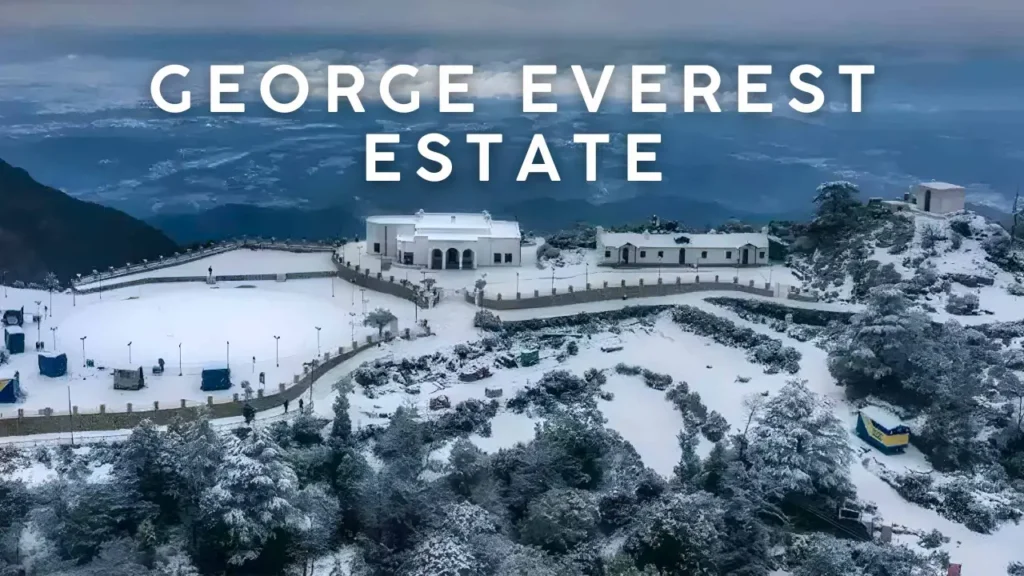
Among Mussoorie’s treasures, the George Everest Estate has always been special. Perched on a ridge with sweeping views of the Doon Valley on one side and the snow peaks of the Himalayas on the other, its potential as a tourism site was obvious long before consultants and project reports confirmed it. I still remember my school days — the slow climb through the pines, laughter of friends echoing on the trail, and at the top, the single tea shop where we sipped steaming chai and shared Maggi. There were no gates, no flashy constructions, just the beauty of the hills in their raw simplicity. That memory is why today’s transformation feels like a loss.
Between 2019 and 2022, the George Everest Estate was given a complete facelift under an Asian Development Bank (ADB)–funded project. Nearly ₹23.5 crore of public money was spent restoring the old Everest House, laying pathways, building parking spaces, toilets, and viewing points. By the end of 2022, the government cut the ribbon with much fanfare. For many, this was projected as the turning point: Mussoorie finally marrying its natural beauty with modern facilities, promising responsible tourism and livelihoods for locals. But the celebrations were short-lived. The ink on the inauguration brochures had barely dried before the government hurried to hand the keys over. On Christmas Day 2022, the Tourism Department floated a tender for managing the estate. By July 2023, Rajas Aero Sports & Adventure Pvt. Ltd. was announced the “winner” of a 15-year lease at ₹1 crore a year. Sounds competitive? Not if you look closer. The other two bidders — Bharuwa Agri Science and Prakriti Organics — also traced back, directly or indirectly, to the same powerful man: Acharya Balkrishna, the close aide of Baba Ramdev.
What looked like an open contest was more like a stage play — the characters different, but the director the same. The government insists the process was open and transparent. Yet as Orwell warned in 1984, when the powerful control the narrative, truth itself becomes a matter of convenience. On paper, three companies competed. In practice, they were siblings under the same patriarchal shadow. The tender, wrapped in bureaucratic jargon about transparency, was a performance — a “managed competition” masquerading as free-market enterprise. The proof lies in the numbers. Rajas Aero Sports, which earlier reported revenue of just ₹1.17 crore, shot up to nearly ₹10 crore in a single year after winning the lease. Economists call this “regulatory capture”; ordinary people call it a windfall. Leader of Opposition Yashpal Arya said it plainly: “The government first spent Rs 23 crore of the ADB loan on beautifying the land worth billions, and then gave it to a private company for 15 years to earn just Rs 15 crore as rent.” He called it a betrayal of trust — public wealth refurbished with taxpayer money, only to be transferred to private hands for a pittance.
The government’s defence is predictable: private operators bring efficiency, investment, and jobs. In theory, yes. In textbooks, certainly. Occasionally, even in practice. But in this case, efficiency seems to mean leasing out 142 acres of restored heritage land at the price of a single bungalow in Dehradun — and then applauding when the company’s profits skyrocket. Crony capitalism dressed up as development. Orwell might have smiled wryly; in 1984 he wrote, “Power is in tearing human minds to pieces and putting them together again in new shapes of your own choosing.” That’s exactly what has happened — truth reshaped, accountability rewritten, and the public asked to cheer. Meanwhile, the fragile hills of Uttarakhand are paying the price. Landslides swallow roads, cloudbursts devastate villages, and forests recede year after year. Migration has hollowed out our villages, with the youth of these mountains leaving for Delhi, Chandigarh, and Dubai in search of dignity and livelihood. Tourism could have anchored them here — with eco-tourism projects, homestays, women-led enterprises, and youth-driven ventures. Instead, the state has opened the gates for big business houses, ensuring that profits fly out while locals are left to sweep the floors.
Yes, private participation in tourism has benefits. It can bring investment, polish, and scale. But when the process is monopolised by a few, when competition is a façade, and when revenue sharing with the state is negligible, then development becomes a charade. As one tea stall owner near George Everest told a reporter, “What was once ours is now theirs — and we are left only as spectators.” That voice carries the weight of an entire state betrayed. The tragedy, then, is not only of one heritage site leased too cheaply. It is of a political economy where public wealth is consistently undervalued, public trust routinely bartered, and public voices systematically sidelined. Ruskin Bond reminded us that once you belong to the mountains, there is no escape. The real question is whether the state still belongs to its people — or only to those with friends in high places.
The hills of Mussoorie, immortalised in Ruskin Bond’s stories as places of peace and belonging, deserve better than to be handed over as fiefdoms. Uttarakhand deserves better than to see its future mortgaged to a few business houses, while its people migrate and its mountains crumble. Development should belong to the people of these hills, not be staged as a play where the ending is always known. Uttarakhand deserves a government that sees hills not as assets to be auctioned, but as sacred trusts to be preserved and nurtured. Because when heritage is sold for cheap profit, the loss is not only of land — it is of faith, belonging, and the promise of a better tomorrow for the people of these mountains.